Ovarian Sex Cord-Stromal Tumors (OSCSTs) are an uncommon category of tumors originating from the sex-cord and stromal tissues of the ovary. Protheragen offers a broad spectrum of services related to OSCSTs. From accurate diagnostics using advanced imaging and biomarker detection to comprehensive therapeutics development through preclinical research and customized solutions, we are committed to advancing the therapeutic development of OSCSTs.
Overview of Ovarian Sex Cord-Stromal Tumor (OSCST)
Ovarian Sex Cord-Stromal Tumors (OSCST) form a small but internally varied family of ovarian masses founded in the sex cord or stromal tissues of the ovary. Their puzzles of cellular architecture led to differing degrees of aggressiveness, but they favor the young: most cases surface in the first twenty or thirty years of life. When viewed as a slice of the wider picture, OSCSTs make up about 7 percent of all malignant ovarian growths. Within the family, adult granulosa-cell-discuss the most, season: years fifty to fifty-five. Even in cases unearthed early, the latent potential to reemerge later, possibly years or decades afterward, looms large, placing lifelong follow-up and intervention firmly on the care pathway.
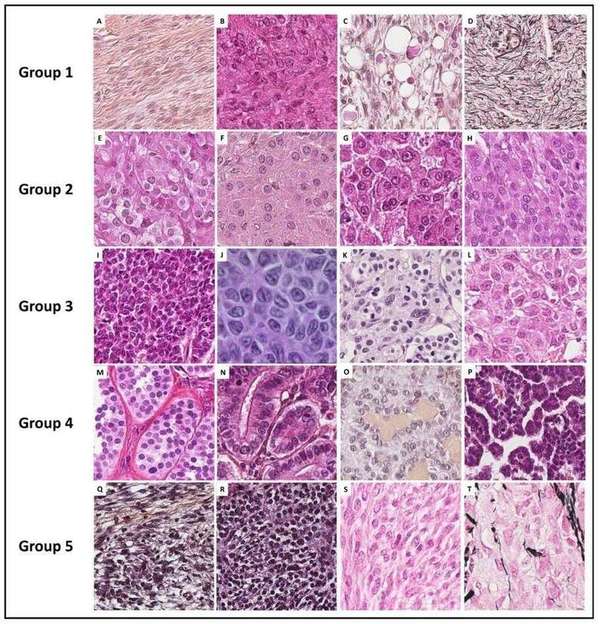
Fig.1 Histopathological illustrations of ovarian sex cord–stromal tumors classified into 5 groups according to predominant cell morphology. (Trecourt A.,
et al., 2023)
Pathogenesis of Ovarian Sex Cord-Stromal Tumor (OSCST)
The pathogenesis of ovarian sex cord-stromal tumors emerges from a complex interplay of genetic and molecular events that govern tumor initiation and advancement. Targeted molecular studies have pinpointed recurrent mutations of clinical relevance; notably, the FOXL2 mutation that predominates in adult granulosa cell tumors and the CTNNB1 mutation that frequently arises in microcystic stromal neoplasms. These lesions correlate consistently with defined histological subtypes, underscoring the utility of refined molecular diagnostics for stratifying patient management. Furthermore, the tumors’ frequent linkage to inherited syndromes, including Peutz-Jeghers syndrome and mutations in the DICER1 gene, reinforces the concept of an inherited background that predisposes the ovarian sex-cord–stromal compartment to neoplasia.
Diagnostics Development for Ovarian Sex Cord-Stromal Tumor (OSCST)
Molecular Diagnostics
Molecular diagnostics have become indispensable when it comes to recognizing and categorizing ovarian sex-cord-stromal tumors (OSCSTs). Technologies like next-generation sequencing (NGS) and custom-designed gene panels allow us to pinpoint precise genetic changes, foremost among them being FOXL2 and CTNNB1 mutations. Identifying these molecular signatures offers more than mere confirmation of histopathological suspicion; it enriches the prognostic conversation and directs therapeutic strategies. Take the FOXL2 mutation in adult granulosa cell tumors: finding it immediately tags the lesion as a well-defined entity that behaves and reacts to therapeutics in remarkably predictable ways.
Immunohistochemistry
Immunohistochemistry (IHC) has become indispensable in the workup of ovarian sex-cord-stromal tumors (OSCST), harnessing antibodies to visualize key proteins on tumor cells. Inhibin, calretinin, and FOXL2 appear in routine stain panels, each contributing to the differential diagnosis of OSCSTs versus other ovarian neoplasms. By cataloging the co-expression and intensity of these markers, pathologists can characterize the histological subtype and infer the tumor's clinical course, thus guiding both prognostic counseling and tailored therapeutics.
Therapeutics of Ovarian Sex Cord-Stromal Tumor (OSCST)
| Therapeutics |
Drug Name |
Mechanism |
Description |
Stage |
| Surgery |
N/A |
Physical removal |
Surgery is the primary therapeutic modality for OSCST. It involves the removal of the tumor, often combined with staging procedures. |
Approved |
| Chemotherapy |
Bleomycin |
DNA cross-linking |
Used in combination with etoposide and cisplatin (BEP regimen) for advanced or recurrent tumors. |
Approved |
| Chemotherapy |
Etoposide |
Topoisomerase II inhibition |
Part of the BEP regimen is used for advanced or recurrent tumors. |
Approved |
| Chemotherapy |
Cisplatin |
DNA cross-linking |
Part of the BEP regimen is used for advanced or recurrent tumors. |
Approved |
| Chemotherapy |
Carboplatin |
DNA cross-linking |
Used as an alternative to cisplatin in combination with etoposide for patients with contraindications to cisplatin. |
Approved |
| Hormonal Therapy |
Aromatase Inhibitors (e.g., Anastrozole, Letrozole) |
Inhibition of estrogen production |
Used in recurrent or advanced tumors to inhibit tumor proliferation by reducing estrogen levels. |
Approved |
| Hormonal Therapy |
Activin A Inhibitor (STM434) |
Inhibition of Activin A signaling |
Investigated for its potential to inhibit granulosa cell tumor proliferation. |
Clinical trials |
| Targeted Therapy |
Tyrosine Kinase Inhibitors (e.g., Imatinib) |
Inhibition of specific tyrosine kinases |
Used in recurrent granulosa cell tumors to stabilize disease progression. |
Clinical trials |
| Targeted Therapy |
Inhibitors of Apoptosis Proteins (e.g., BV-6) |
Induction of apoptosis |
Studied for their potential to induce apoptosis in granulosa cell tumors. |
Preclinical studies |
Disclaimer: Protheragen focuses on providing preclinical research services. This table is for information exchange purposes only. This table is not a treatment plan recommendation. For guidance on treatment options, please visit a regular hospital.
Our Services
Protheragen offers a comprehensive suite of services for the diagnostics and therapeutics development of Ovarian Sex Cord-Stromal Tumors (OSCST). Our services include molecular diagnostics, targeted therapies, hormonal interventions, and immunotherapies, supported by state-of-the-art technologies and a team of experienced scientists.
- KGN CDX Models
- COV434 CDX Models
- Transgenic Mouse Model (Inhibin α-Subunit Promoter)
- LH Hyperstimulation Model (α-LHβCTP)
- Ovarian-Specific Promoter Model (OSP-TAg)
Protheragen specializes in preclinical research, offering in vitro and in vivo modeling, molecular analysis, and drug efficacy testing to accelerate the discovery and development of novel diagnostics and therapeutics. Our customized services are designed to meet the specific needs of each project, ensuring tailored solutions for the development of effective diagnostics and therapeutics. If you are interested in our services, please feel free to contact us.
References
- Trecourt, Alexis, et al. "Relevance of Molecular Pathology for the Diagnosis of Sex Cord–Stromal Tumors of the Ovary: A Narrative Review." Cancers 15.24 (2023): 5864.
- Al Harbi, Rehab, Iain A. McNeish, and Mona El-Bahrawy. "Ovarian sex cord-stromal tumors: an update on clinical features, molecular changes, and management." International Journal of Gynecological Cancer 31.2 (2021): 161-168.
- Pinto, Mariana Tomazini, et al. "Molecular biology of pediatric and adult ovarian germ cell tumors: a review." Cancers 15.11 (2023): 2990.
All of our services and products are intended for preclinical research use only and cannot be used to diagnose, treat or manage patients.


